Need to convert grams to milliliters for a recipe? Our free grams to mL converter helps you measure water, milk, cooking oil, honey, and other common kitchen liquids.
Simply enter the weight in grams, select your ingredient, and get an instant volume conversion in milliliters. The calculator accounts for differences in ingredient density, so you don’t have to assume that every 100 grams equals 100 mL.
Choose your ingredient
Choose below or use the menuThe result depends on the density of the selected liquid.
Convert your measurement
Measurement standards & accuracy
Grams measure mass and milliliters measure volume. Results use approximate ingredient densities. Water is estimated at 1 g/mL. Other liquids can vary by brand, composition, and temperature.
How to Convert Grams to Milliliters
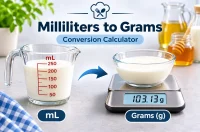
Grams (g) measure mass, while milliliters (mL) measure volume. To convert between them, you need to know the density of the ingredient.
Use this simple formula:
Milliliters (mL) = Grams (g) ÷ Density (g/mL)
For example, water has an approximate density of 1 g/mL, so 100 grams of water equals approximately 100 milliliters. Honey is denser, meaning the same weight occupies less space.
100 Grams to mL Conversion Chart
The following table shows how many milliliters are equivalent to 100 grams of common cooking liquids, using the approximate densities in our calculator.
| Ingredient | Grams | Milliliters (mL) |
|---|---|---|
| Water | 100 g | 100 mL |
| Whole milk | 100 g | 96.96 mL |
| Vegetable oil | 100 g | 119.49 mL |
| Olive oil | 100 g | 109.53 mL |
| Honey | 100 g | 70.41 mL |
| White vinegar | 100 g | 98.99 mL |
| Lemon juice | 100 g | 96.96 mL |
| Soy sauce | 100 g | 92.78 mL |
| Maple syrup | 100 g | 75.83 mL |
| Heavy cream | 100 g | 104.22 mL |
| Coconut milk (canned) | 100 g | 104.69 mL |
Values are approximate and rounded to two decimal places. Actual densities depend on product composition, brand, and temperature.
Is 100 Grams the Same as 100 mL?
Not always. For water, 100 grams is approximately equal to 100 mL. However, this relationship does not apply to every ingredient.
- Water: 100 g is approximately 100 mL.
- Milk: 100 g is approximately 97 mL.
- Vegetable oil: 100 g is approximately 119.5 mL.
- Honey: 100 g is approximately 70.4 mL.
Always select the correct ingredient when converting between weight and volume.
Frequently Asked Questions
How many mL are in 1 gram?
For water, 1 gram is approximately 1 mL. For other liquids, the result depends on density. For example, 1 gram of honey is approximately 0.7 mL.
How many mL is 50 grams of water?
50 grams of water is approximately 50 mL.
How many mL is 200 grams of milk?
Using the calculator’s approximate density for whole milk, 200 grams is about 193.92 mL.
Can I convert grams to mL for flour or sugar?
Flour and sugar can also be converted from mass to volume using appropriate bulk-density estimates. However, this particular calculator focuses on common cooking liquids and does not include dry ingredients.
Can I convert milliliters back to grams?
Yes. Click the swap button in the calculator to change the conversion direction from mL to grams while keeping your selected ingredient.
Tips for Accurate Cooking Measurements
Density-based conversions are useful for everyday cooking, but measurements may vary between products. For recipes requiring high precision, particularly baking, use a digital kitchen scale whenever possible.